Video advertising is one of the most profitable formats in digital marketing. However, for publishers, the decision on how to deploy video on a website significantly affects not only user experience (UX) but, most importantly, overall revenue.
To get the most out of your video inventory, you must perfectly understand the difference between Instream and Outstream video, correctly declare attributes like sound and placement (plcmnt), and strategically deploy individual positions.
1. Fundamental Difference: In-stream vs. Out-stream
The main difference lies in whether the website naturally includes video content (e.g., news video, stream) or if you are inserting an advertisement into a text environment.
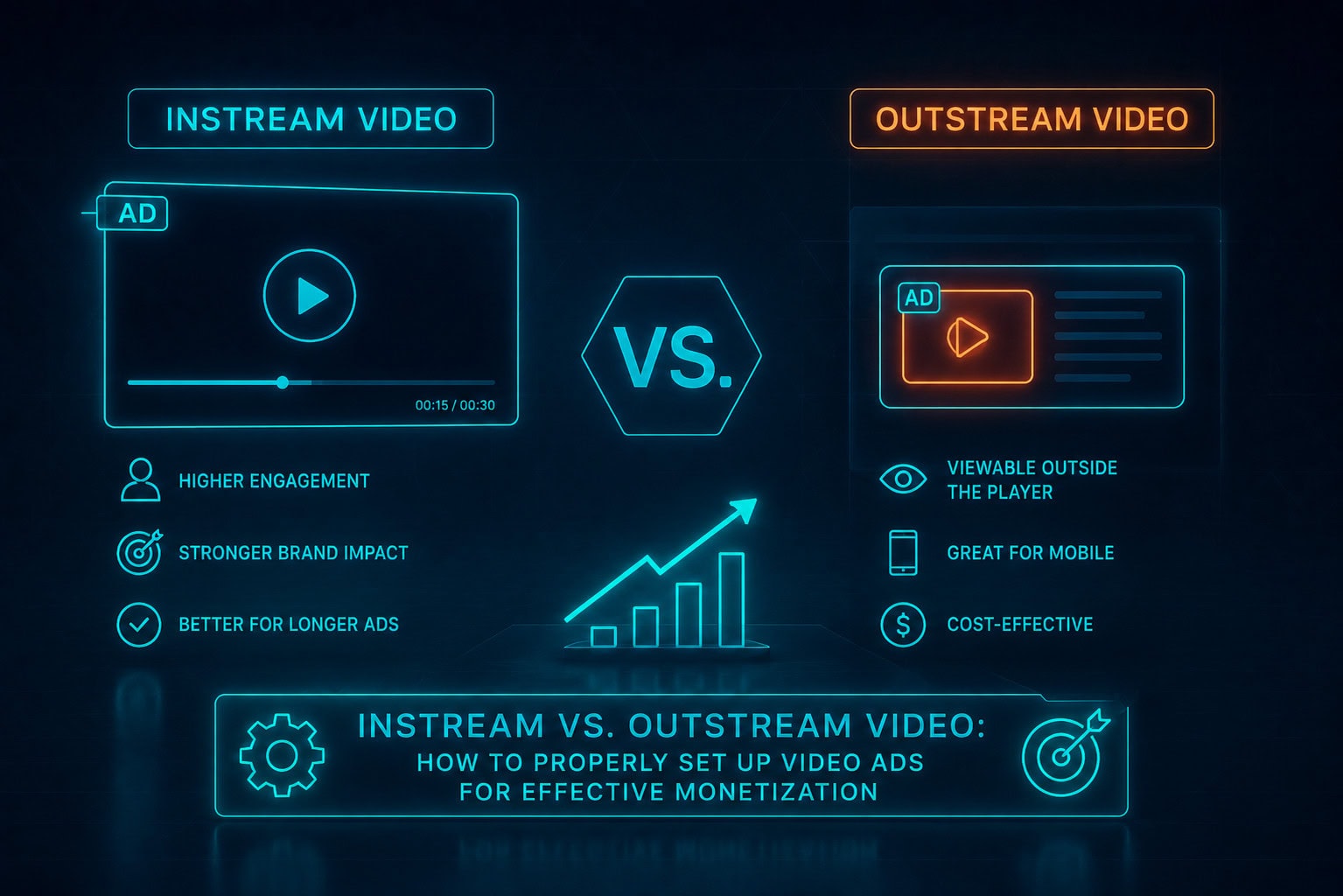
Instream video ad
The ad is playing inside the existing video player before, during, or after the main video content that the user came to watch.
- Monetization potential: Very high. Advertisers like instream because the user already has sound on and is paying close attention to the screen.
- Condition: As a publisher, you must produce and own editorial video content.
Outstream video ad
The ad is displayed video content, most commonly between paragraphs of text in an article (In-Read), in the corner of the screen (Slider/Sticky), or as an interstitial (between pages). The player only scrolls into view when it is visible on the screen (viewable).
- Monetization potential: Medium to high, but with a huge advantage – scalabilityYou don't need any of your own videos, just text content (articles) is enough for you.
- Usage: Ideal for blogs, magazines, and news websites that lack a video editorial team.
2. Technical Declaration: Why Does Your Money Depend On It?
Programmatic buying (OpenRTB) operates on precise rules. If you do not provide advertisers with the correct information within the bid request, your ad slots will either not be purchased, or will be purchased for a fraction of the price.
When optimizing monetization, you must mandatorily and correctly declare these parameters:
A. Sound status (Muted vs. Unmuted)
- Unmuted (so sound turned on): Typical for Instream. The user expects sound (since they started watching a video). These positions have highest eCPMbecause they deliver the highest impact and emotion.
- Muted Common for Outstream. The ad starts silently, and the user must click on it to enable sound. If Outstream played loudly immediately after the page loaded, the user would leave the website instantly (high bounce rate). Advertisers pay less for muted video, but the click-through rate (CTR) tends to be stable.
B. Parameter Replacement (Placement according to IAB standards)
In the updated IAB specifications (OpenRTB 3.0 / Video Placement Update) strictly distinguishes where the video is located. Correctly assigning the plcmnt value protects the publisher from penalties for deceiving advertisers.
3. Position Types and Their Monetization Power (Preroll, Midroll, Postroll)
These terms are primarily related to Instream video, its proper placement dramatically changes publisher revenue.
Pre-roll (Before the video)
Ad that plays before the editorial video itself.
- From a monetization perspective: It has the highest completion rate because the user is willing to wait 10-15 seconds to see the video they came for.
- Tip: Always allow skippable ads after 5 seconds if they are longer creatives, otherwise you risk user drop-off.
Midroll (During video)
An advertisement that interrupts a video mid-stream (similar to TV).
- From a monetization perspective: Very lucrative format, but suitable only for longer content (videos longer than 3-5 minutes). The user is already engaged with the content, so they watch the ad.
- Tip: If you only have 30-second clips, don't insert midrolls. You'll ruin the UX and won't earn anything.
Post-roll (After the video)
Advertisement that starts immediately after the main video ends.
- From a monetization perspective: It has the lowest value and the lowest CPM. The user leaves or closes the tab at the end of the video.
- Tip: Postroll used within the so-called autoplay playlistsAnd if another interesting video automatically follows the postroll, you will maintain attention and increase revenue.