
The share of users with active adblocking is typically between 20-40%, depending on the market. For the publisher, this means a significant amount of unused inventory and a direct loss of potential revenue.
However, it is also a sensitive topic - aggressively bypassing adblocking can damage user trust and the media brand. The goal is therefore not to "beat" the user, but to find a model that is economically functional and fair at the same time..
Why do users use Adblock
If we want to monetize, we need to understand motivation.
Most common reasons:
- Too aggressive formats (interstitials, autoplay video)
- Slow website
- Privacy concerns
- Too much ad saturation
- Bad UX experience
Adblock is often a symptom of bad ad design, not the primary problem.
Rethinking Adblock User Monetization: Fundamental Approaches
In practice, two main models are most commonly used:
- Hard paywall / content blocking
- Soft message + request to turn off
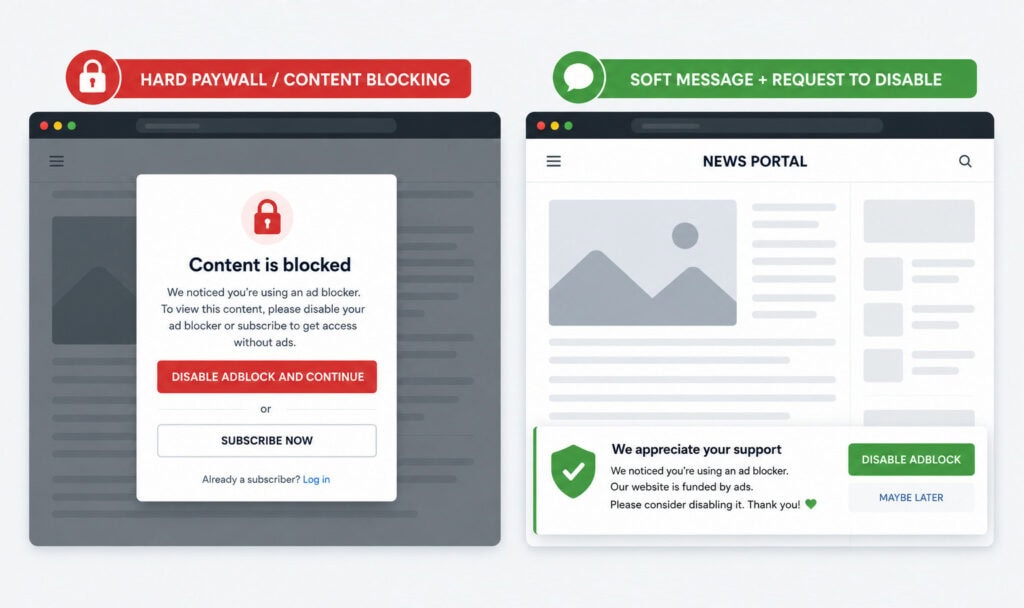
Hard anti-adblock: blocking content
Technically, it's about adblock detection and then:
- complete blocking of the article
- Page overlay with a challenge
- redirect to paywall
Advantages:
- High conversion rate for adblocker disable (short-term)
- Clear monetization policy
- Strong content value signal
Risks:
- Increased bounce rate
- Casual traffic strata
- Risk of circumventing technology
This model works better for:
- strong news brands
- unique content
- high willingness to pay markets
2. Soft message: education and transparency
A less aggressive approach is to show users with adblock:
- explanation that advertising funds content
- Request to disable blocker
- offer an alternative (e.g., subscription)
Effectiveness increases significantly if communication contains:
- specific explanation of costs
- promise to limit aggressive formats
- privacy transparency
Practical recommendations:
- Don't show the prompt on every page view
- Test wording and design
- Segment by engagement
Among engaged users, the adblock disable rate tends to be higher than among random visitors.
Technological bypass of Adblock – You must be careful
Some solutions try to change ad tag names, load ads server-side, or use obfuscated scripts. This may work in the short term, but it increases technological complexity, risks user conflict, and can also damage brand trust. A long-term sustainable strategy is based on value, not on technical "hacking."
Economic Viewpoint: Is It Worth Fighting for Every Adblock User?
Not always.You have to ask yourself:
- What is the value of this segment?
- What is his engagement?
- Is he willing to pay?
- Or is it low-value, random traffic?
Sometimes it is more reasonable:
- Focus on improving viewability
- Increase CPM for non-adblock users
- Optimize demand mix
Increasing RPM by 10 % may have a greater impact than trying to retain 5 % users with low engagement.
Strategic framework for a publisher
To systematically address adblock monetization, follow these steps:
1. Audit
- Adblock User Percentage
- Share of pageviews
- Engagement metrics (time, scroll depth)
- Geographic distribution
2. Segmentation
- Casual vs. loyal users
- Mobile vs. desktop
- Social vs. Direct Traffic
3. Testing
- Soft block vs. hard block
- Subscription Offer
- UX changes (reduction of aggressive formats)
4. Long-term optimization
- Reduction of most hated formats
- Page speed improvement
- Transparent Communication
UX as the basis for monetization
The most effective monetization strategy for Adblock users is paradoxically: Improve the advertising ecosystem so that fewer people want to block it.
That means:
- Less aggressive formats
- Higher viewability instead of higher saturation
- Faster loading
- Fewer layout shifts
- Better mobile optimization
Conclusion
Monetizing users with active Adblock is not primarily a technological, but a strategic and product problem. Trying to "outsmart" ad blockers may yield short-term results, but often leads to a worse user experience and erodes trust in the medium.
A more successful approach involves understanding the reasons why users block ads and finding a balanced model between the needs of the publisher and the expectations of visitors. Transparent communication, a reasonable ad load, a quality user experience, and appropriate audience segmentation can yield better results than aggressive anti-adblock solutions.
Publishers should therefore view Adblock users not as adversaries, but as feedback on the quality of the advertising ecosystem. Long-term revenue growth does not come from battling users, but from building an environment where advertising remains an acceptable part of the content. The best defense against the increasing use of Adblock is therefore often not stricter technology, but a better product.