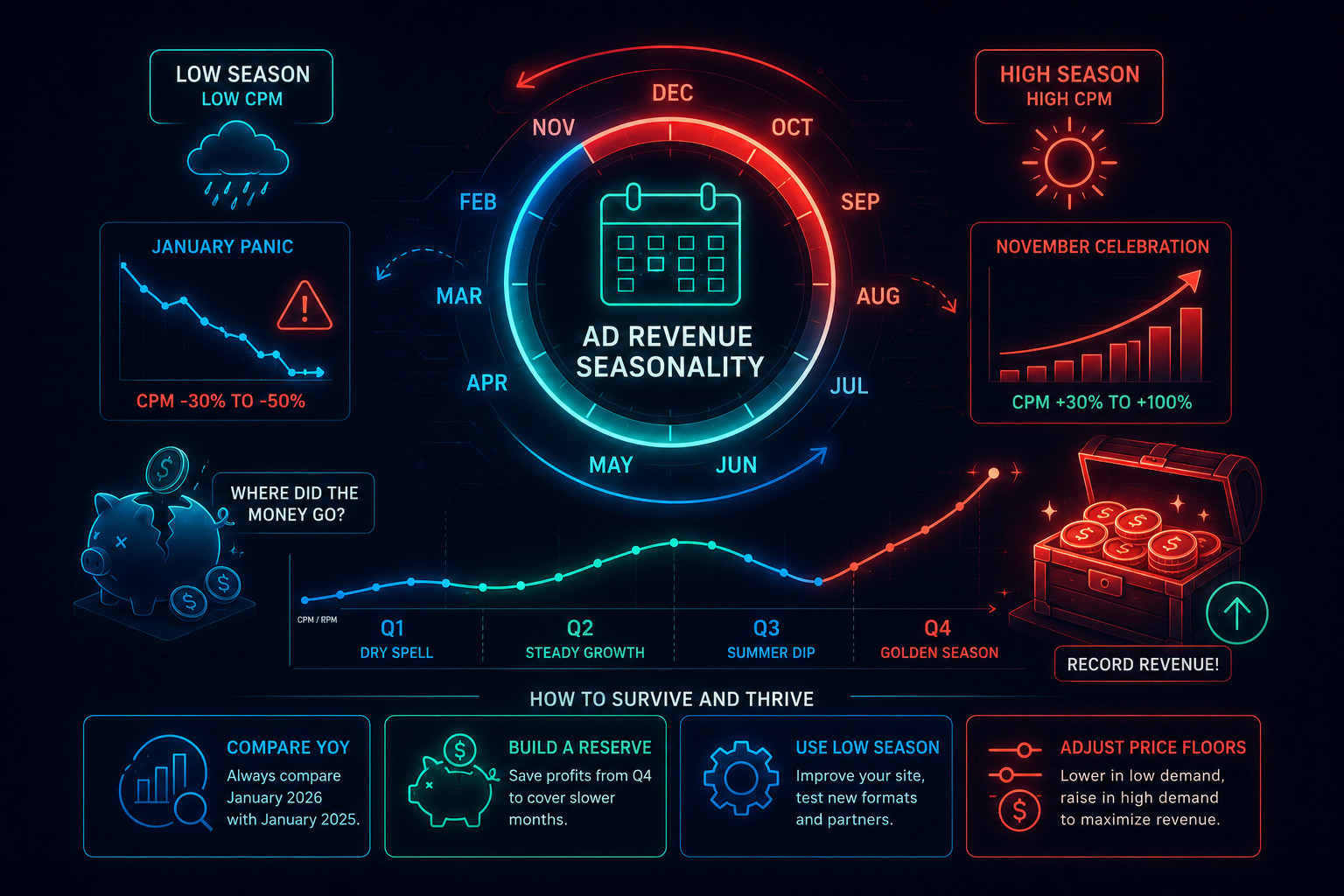
You wake up to the new year full of resolutions, check your website's analytics, and get a shiver down your spine. While your website traffic is stable, Ad revenue (both RPM and CPM) plummeted by 30 to 50%You frantically check the codes, test, verify the presence of ads.txt, and ask yourself: Where did I make a mistake?
We have good news and bad news for you.
- Bad news: You lost money.
- Good news: You haven't ruined anything. You became a "victim" seasonality in online advertising.
Let's take a look together at why the advertising market is like a rollercoaster, when to expect a harvest, and how to survive the January drought without any heart attacks.
Why do advertiser budgets fluctuate? (A behind-the-scenes look)
To understand why your revenue fluctuates, you need to put yourself in the shoes of the companies that buy advertising from you (advertisers). Their behavior is influenced by three main factors:
1. Quarterly planning and budgets
Most companies plan their marketing budgets quarterly (Q1 to Q4).
- Beginning of the quarter (especially January in Q1) is characterized by the approval of new budgets, strategy setting, and a cautious start. While corporate approval wheels turn, advertising runs at half throttle.
- End of quarter (especially March, June, September, and December) brings the opposite extreme. Marketers have a clear task ahead of them: We have to spend everything we have left by the end of the month, otherwise our budget will be cut next quarter. The result is aggressive bidding in auctions and a sharp increase in CPM.
2. Consumer Shopping Spree
Advertisers advertise when people shop.
In November and December (Q4), the shopping fever of the year peaks – Black Friday, Cyber Monday, and Christmase-shops and brands are going all out and outbidding each other in auctions for every available ad spot on your website to capture customers.
In January (Q1), people's wallets are empty, and marketing departments have a post-season slump. Demand for advertising dramatically decreases.
3. Summer slump
In July and August (Q3), people are on vacation, spending time outdoors, and the sales of most online shops decline. With them, the interest of advertisers in pushing money into the online space also decreases. It is not uncommon to have better traffic in July than in June, but to see a decline in revenue.
Publisher's Year in Brief: What awaits you over the next 12 months?
| Quarter | Market status | What is happening with your income? |
| Q1 (January - March) | Seasonal drought | January is the weakest month of the year. CPM hits rock bottom. In February, there's a slight revival (Valentine's Day), and March brings the first solid numbers thanks to the end of the quarter. |
| Q2 (April – June) | Stable growth | Spring campaigns are in full swing (Easter shopping, preparing for summer). Revenues are stable, healthy, and June brings a strong end to the quarter. |
| Q3 (July – September) | Summer slowdown and restart | July and August are slow (due to holidays). However, in September, the "Back to School" campaign arrives and the market begins to awaken. |
| Q4 (October – December) | Golden Mine | Most profitable time of the year. October builds momentum, November (Black Friday) and December (Christmas) mean historical highs for your RPMs. |
How to survive the January drought and prepare for seasonality?
Since seasonality is a natural market phenomenon, you cannot completely eliminate it. However, you can minimize its impacts and prepare for it so that it doesn't surprise you.
1. Measure success year-over-year (YoY), not month-over-month
Never compare January to December.
Rule of a successful publisher: Always compare. January 2026 with January 2025This is the only way you'll know if your website is actually growing or stagnating.
2. Build a financial cushion in Q4
When you see record amounts on your account in November and December, don't zero them out. Set aside a portion of your Q4 profits to cover slower months (January, July). Think of it as a strong year-end paying you in advance for a slower start to the new one.
3. Use the "dry" period for technical cleanup
When ad prices are low, you lose the least money if something on the web isn't working. January and July are ideal months for:
- Website redesign and ad unit layout change
- Web performance optimization (Core Web Vitals)
- Testing new advertising partners or formats
- Code cleanup and removal of old scripts
4. Optimize Price Floors
During periods of low demand (January), it may be reasonable to slightly decrease minimum ad impression prices (price floors) to maintain a reasonable fill rate. Conversely, in October and November, increase the price floor as advertisers are willing to pay significantly more.
Conclusion: Seasonality is a friend, if you know how to handle it
Fluctuations in ad revenue are not a bug in your system – they are the pulse of the global economy. The key to successful monetization is to not panic when the curve goes down, while simultaneously getting the absolute maximum out of it when it shoots up.