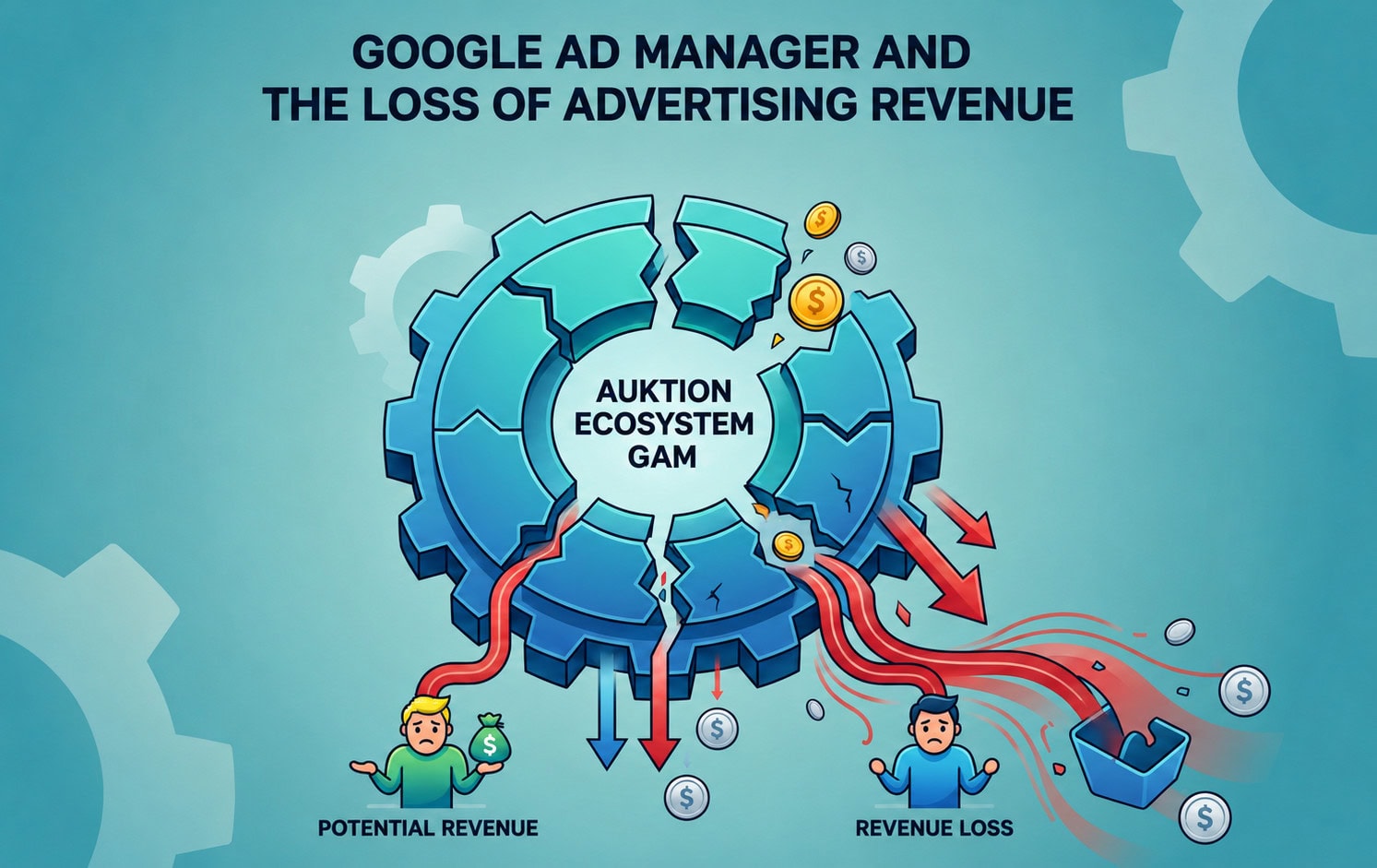
How does monetization through Google Ad Manager work, and where is money most often lost?
Monetization through Google Ad Manager (GAM) is not just about deploying ad units. It's about managing an auction ecosystem where details matter: line item structure, correctly set priorities, and real competition in the auction.
Many publishers have been using GAM for years, yet they don't grasp its auction logic. This results in a situation where the system technically functions, but financial performance lags behind the inventory's potential.
How does an auction work in Google Ad Manager
Simply put, Google Ad Manager evaluates which line item has the right to be displayed in a specific ad slot. The decision is made based on a combination of:
- line item priority
- campaign types
- set prices (CPM or floor)
- competition with AdX
If Google Ad Exchange (AdX) is also implemented, the auction expands to include external demand. In a unified auction environment, direct campaigns and programmatic demand then compete for impressions.
Theoretically, it's an optimized system maximizing revenue. In practice, however, a lot of money is lost precisely due to incorrect configuration.
Line items: the foundation where most errors occur
A line item is the basic unit of sale in GAM. Each campaign – direct, sponsorship, network, or programmatic – is represented by specific delivery conditions.
The most common problems arise in these areas:
- Incorrectly set line item type
- conflict between direct and programmatic items
- too broad targeting rules
- Outdated or inactive items blocking inventory
For example, if a Standard line item is set with a low CPM but with a higher priority than AdX, it can systematically push out higher-value auction demand.
Equally dangerous are forgotten line items with broad targeting that "steal" impressions without generating optimal returns.
2. Priority: Misunderstood delivery hierarchy
One of the biggest sources of financial loss is the misunderstanding of system priority in GAM.
Google Ad Manager works with a fixed hierarchy of priorities. Simplified:
- Sponsorship of Standard campaigns have a higher priority
- Network, Bulk, AdX have lower priority
- Price Priority competes based on price.
- The house is used to fill unsold space with a self-promotion campaign
If the priority is set incorrectly, a situation may arise where:
- low-cost direct campaign blocks higher programmatic bid
- The guaranteed campaign is overflowing at the expense of more profitable slots
- Programmatic demand has no chance to enter the auction.
Publishers often think they have "everything hooked up," but in reality, the auction is won by the line item with higher priority, not higher value.
This leads to the so-called hidden cannibalization of revenue.
3. Competition: insufficient competition in the auction
Programmatic monetization relies on competition. The more relevant bidders that participate in an auction, the greater the likelihood of eCPM growth.
Losses primarily occur when:
- AdX is not configured correctly in unified pricing rules
- Floor prices are too low or too high
- header bidding is not implemented
- Are there restrictions in blocking controls
If only a limited number of buyers participate in the auction, the price stagnates regardless of inventory quality.
Competition must be managed strategically – the goal is not to maximize the number of partners without control, but to increase effective bid density without negatively impacting latency.
How to minimize losses in Google Ad Manager
A systematic approach should include:
- regular audit line items
- priority hierarchy control
- optimizing unified pricing rules
- Delivery vs. Potential Revenue Analysis
- Testing floor prices
Monetization in Google Ad Manager isn't a static configuration. It's a continuous optimization process.
Conclusion
Google Ad Manager is an extremely powerful tool. However, its complexity is a double-edged sword. If a publisher doesn't understand the mechanics of line items, priorities, and auction competition, the system, while delivering ads, won't generate the maximum possible revenue.
Money is most often lost not through dramatic losses, but through minor configuration errors that undervalue inventory over the long term.
In the environment of programmatic monetization, it's not just traffic volume that matters. The quality of the auction is what matters – and in Google Ad Manager, that is entirely in the publisher's hands.