For publishers, the difference between a profitable year and stagnation often lies not just in the number of new articles, but in how effectively they can monetize their existing space. If you're using Google Ad Manager as your ad server and aren't experimenting, you could be losing a significant portion of your revenue.
What are Google Ad Manager Experiments?
Tool Experiments In the Google Ad Manager environment, this allows publishers to test changes to ad settings on a small portion of their traffic before applying them to the entire site. The system automatically segments users and compares the performance of the original setting(Control) with a new proposal (Experiment).
Key reasons to start testing right now:
1. Data-driven decision making, not gut feeling
Many publishers are afraid to increase the minimum price (floor price)because they are concerned about a drop in the fill rate. The experiment will tell you exactly: "Yes, the fill rate dropped by 5 %, but the overall eCPM increased by 12 %, which means a net revenue increase of 7 %."
2. Safe optimization without risk
Have you ever deployed a change that accidentally "broke" your revenue for the whole weekend? This won't happen with experiments. If a tested version shows a loss, you simply end it with one click. Your main revenue stream, however, remains safe.
3. Understanding Auction Dynamics
What worked for a Christmas campaign may not work in April. Regular experimentation helps you understand how buyers(DSPs) react to your changes in real time.
What can you test in Google Ad Manager?
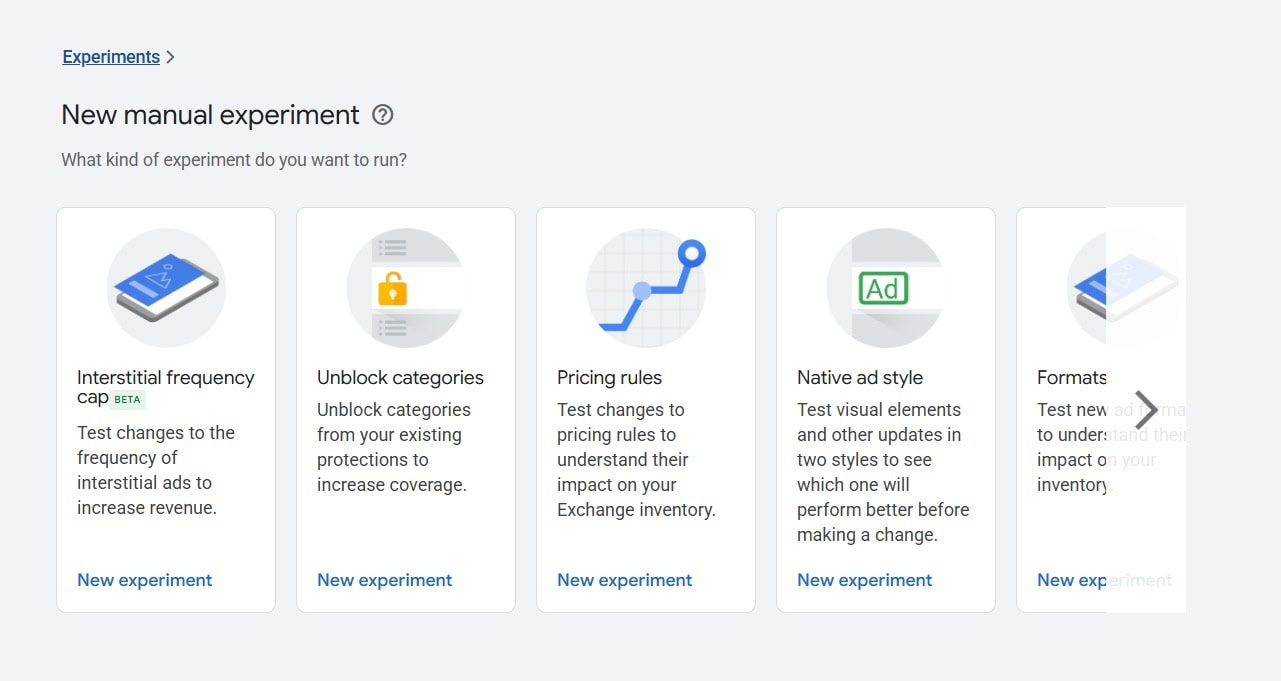
Within the Experiments interface, you have several key test types available:
- Pricing Rules The most common test when optimizing monetization. Try different minimum price levels for specific countries, devices, or formats.
- Blocking Controls: Test the allowance of a specific category from the blocked ones and test if this increases the fill rate.
- Interstitial Display FrequencyShortening the format's redisplay time can help increase your revenue.
- Formats Can you activate and track what benefit launching new special formats would have?
The advantage of experiments is the ability to set the percentage of traffic to which the experiment will be applied, the time frame for its duration, and also a threshold for decline. vCPM or revenue, at which point the system would automatically stop the running experiment.
Strategic approach for a successful experiment
To get relevant results, stick to this procedure:
- Set one variable: Never test price and formats at the same time. You won't know what caused the change.
- Sufficient sample Do not end the experiment after two days. Let it run for at least 7 to 14 days to cover fluctuations within a week (workdays vs. weekend).
- Track Revenue per Session: Don't just look at eCPMIf a new ad increases eCPM but drives people away from the site, you're losing money overall.
Conclusion: The "Test & Learn" Culture
In the digital world, there's no such thing as a "final setup." The most profitable online publishers are those who have experimentation in their DNA and regularly work with it.