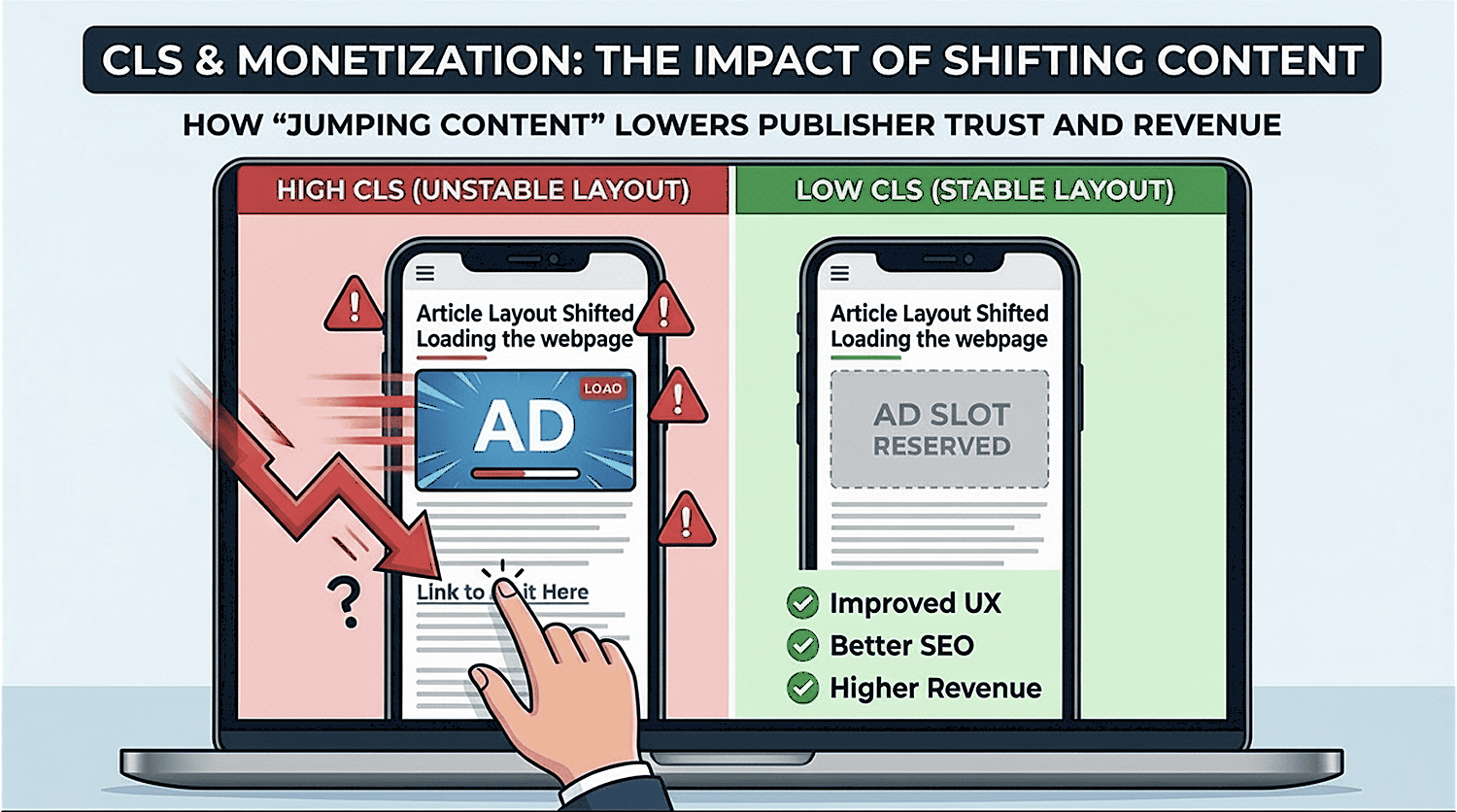
Online publishers often deal with eCPM, fill rate, or floor prices. But one metric that is often underestimated has a fundamental impact on SEO, UX, and revenue: CLS – Cumulative Layout Shift.
If content "jumps" for the user while reading due to loading ads, it's not just an unpleasant experience. It's a problem that Google is actively evaluating.
What is CLS and why is Google tracking it?
CLS is part of the Core Web Vitals – a set of metrics that Google uses to evaluate user experience.
Officially, CLS is defined as a metric that measures the visual stability of a page. In other words: How much do the elements on the page shift during its loading.
If the advertisement arrives late and "pushes" the text below, the user can:
- Click on the wrong element
- lose a place in the text
- Leave page
Google has long emphasized the importance of Core Web Vitals as a ranking factor. CLS is one of them.
How does Google perceive a publisher with high CLS?
If we look at the problem systematically, high CLS means:
- Worse user experience
Google optimizes search for users, not for advertising systems. - Potential negative impact on SEO
Although CLS is not the only ranking factor, it can be decisive in competitive topics. - Indirect impact on monetization
High CLS often means:
- higher bounce rate
- lower time on page
- lower number of pages viewed per session
This directly affects the number of impressions and the inventory value.
Why does advertising specifically cause the biggest CLS problem?
Most common scenario:
- The page is loading.
- The ad slot does not have creative yet.
- After a few hundred milliseconds, a banner of a different height loads.
- The content will shift.
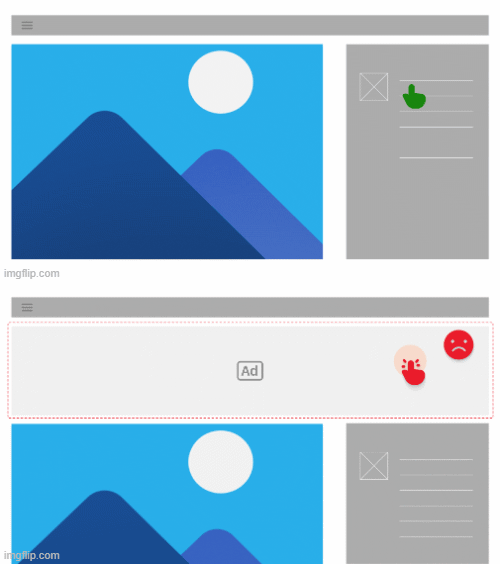
The problem is that ad systems have historically allowed dynamic sizes (e.g., 300x250, 300x600, 320x100, etc. in one slot).
Multiple dimensions in one slot will fill advertising spaces, but it can be a bad experience for the user due to an unstable layout!
Our approach with publisher Zoznam.sk: fixed placeholders and fixed slot height
When optimizing monetization for publishers, we addressed a specific problem:
- High CLS caused by dynamic banner heights
- lower page stability
- negative UX signals
Solution: fixed placeholder + strictly defined height
We have implemented:
- Placeholder is fixed height in the DOM on page load
- Request creative slots with a precisely defined height
- Separate slots for different formats (instead of multi-size mix)
Result
- drastic reduction in CLS
- stable layout
- No text-hopping
CLS as part of a monetization strategy, not a technical detail
Many publishers address content jumping only when a problem appears in Search Console.
From our perspective, however, CLS should be:
- part of the revenue audit
- Key Performance Indicators (KPIs) for Ad Stack Optimization
- factors in the implementation of header bidding
Modern yield management is no longer just about who offers the highest bid. It's also about how advertising fits within the user experience.
Practical checklist for publishers
Check yourself:
- Does every ad slot have a reserved space even before the creative loads?
- Are you using multi-size slots without a fixed height?
- Are you tracking CLS separately for article pages vs. the homepage?
- Do you have CLS as part of a monetization technical audit?
If the answer to any question is "no," you probably have room for improvement.
Conclusion
CLS is not just an SEO metric.
It's a metric of trust, user experience, and indirectly, revenue.
A publisher whose content "jumps" isn't just sending a bad signal to Google. It's sending one to readers – and advertisers!
A stable layout is now considered a basic prerequisite for effective monetization.